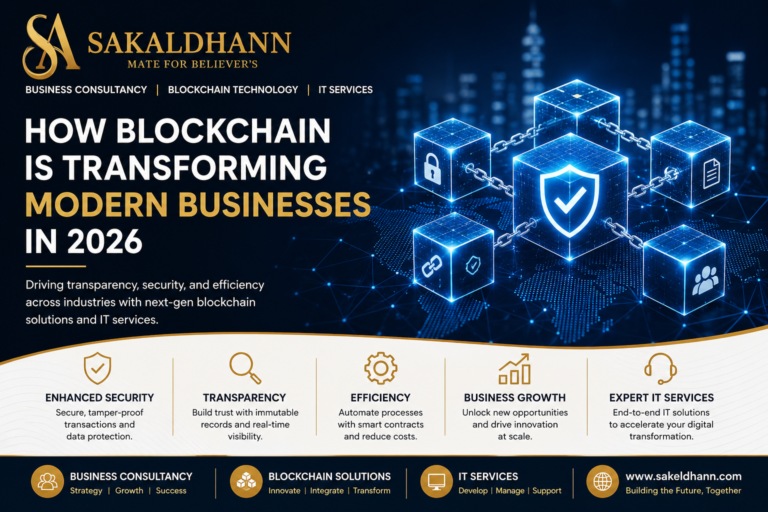
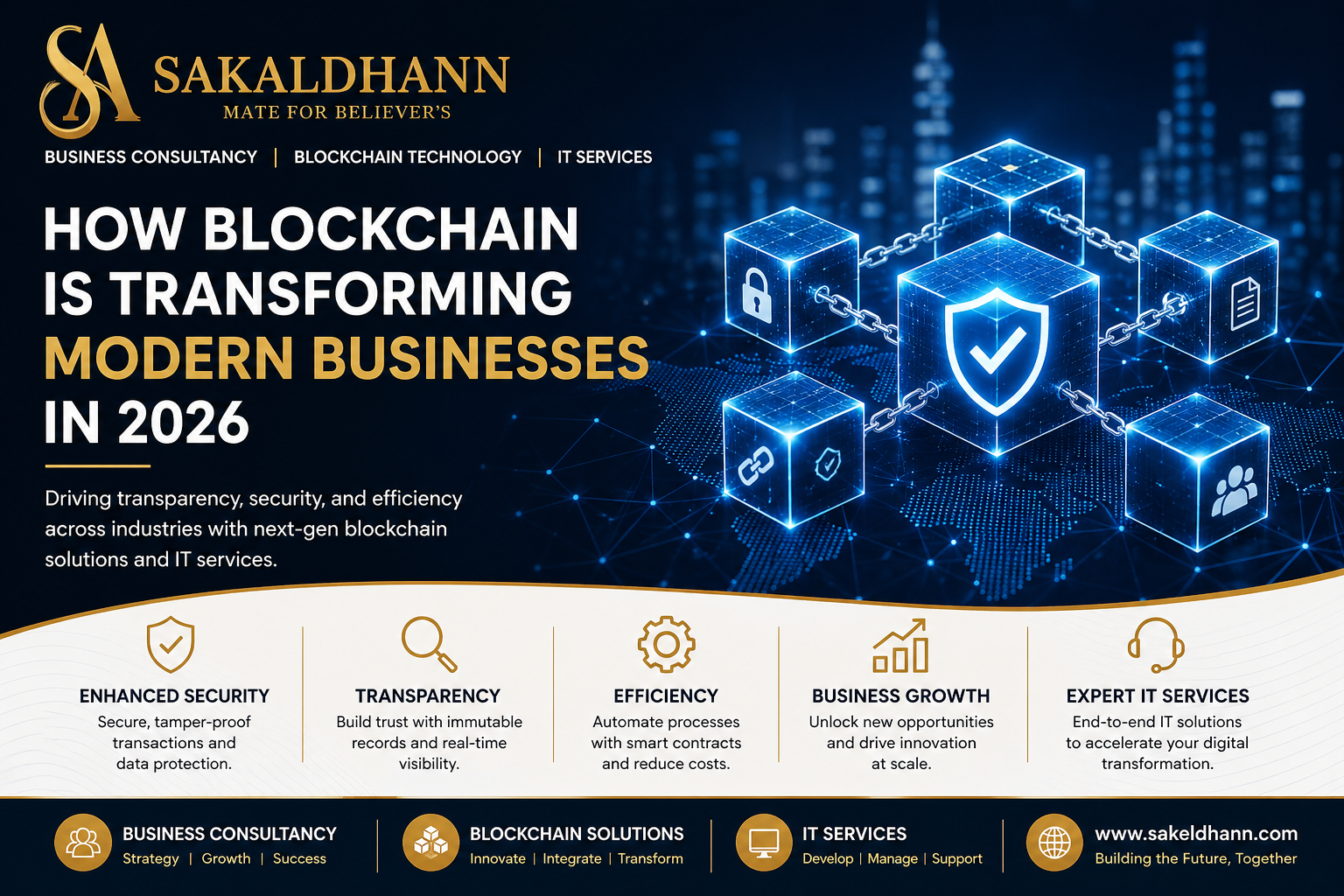
How-Blockchain-is-Transforming-Modern-Businesses-in-2026.png
In 2026, blockchain technology has moved far beyond its early association with cryptocurrencies and is now a powerful driver of innovation across industries. Businesses are no longer asking whether they should explore blockchain—they are asking how quickly they can adopt it to stay competitive. From improving transparency to automating operations, blockchain is reshaping how organizations function, build trust, and deliver value.
For companies like Sakaldhann, which focus on blockchain technology and IT services, this shift presents a massive opportunity to guide businesses through a rapidly evolving digital landscape.
What is Blockchain and Why It Matters Today
At its core, blockchain is a decentralized digital ledger that records transactions across multiple systems in a secure, transparent, and tamper-resistant way. Unlike traditional databases controlled by a single entity, blockchain operates on a distributed network, making it more secure and trustworthy.
In 2026, businesses value blockchain for three main reasons:
- Transparency: Every transaction is visible and verifiable
- Security: Advanced cryptography protects data from tampering
- Decentralization: Eliminates reliance on a single authority
These features are especially important in a world where data breaches, fraud, and inefficiencies can cost businesses millions.
Key Ways Blockchain is Transforming Businesses1. Enhancing Transparency and Trust
Trust has always been a critical factor in business relationships. Blockchain eliminates the need for intermediaries by creating a shared, immutable record of transactions.
For example:
- In supply chains, businesses can track products from origin to delivery
- Customers can verify product authenticity instantly
- Financial transactions become fully auditable
This level of transparency builds stronger relationships with customers, partners, and stakeholders.
2. Revolutionizing Supply Chain Management
Supply chains have traditionally been complex and prone to inefficiencies. Blockchain simplifies this by providing real-time tracking and verification.
Benefits include:
- Reduced fraud and counterfeit goods
- Faster tracking of shipments
- Improved inventory management
- Better coordination between suppliers and distributors
In 2026, industries like retail, pharmaceuticals, and manufacturing are heavily relying on blockchain to streamline their operations.
3. Smart Contracts: Automating Business Processes
One of the most powerful features of blockchain is smart contracts—self-executing agreements coded on the blockchain.
These contracts automatically execute when predefined conditions are met, eliminating the need for manual intervention.
Use cases include:
- Automatic payments after service completion
- Contract enforcement without legal delays
- Streamlined vendor agreements
This reduces operational costs, minimizes errors, and speeds up business processes.
4. Strengthening Cybersecurity
Cybersecurity remains a top concern for businesses worldwide. Traditional centralized systems are vulnerable to hacking and data breaches.
Blockchain enhances security by:
- Storing data across multiple nodes instead of one central server
- Using encryption to protect sensitive information
- Making unauthorized changes nearly impossible
As cyber threats continue to rise, businesses are turning to blockchain as a more secure alternative.
5. Improving Financial Transactions
Financial services have been one of the biggest beneficiaries of blockchain technology.
Key advantages include:
- Faster cross-border payments
- Reduced transaction fees
- Elimination of intermediaries
- Real-time settlement
Businesses can now handle transactions more efficiently, especially in global markets where delays and costs were once major challenges.
6. Enabling Decentralized Applications (DApps)
Blockchain has enabled the rise of decentralized applications, or DApps, which operate without a central authority.
These applications offer:
- Greater control to users
- Reduced dependency on centralized platforms
- Increased transparency
Businesses are leveraging DApps for services like finance, gaming, and digital identity management, opening up entirely new revenue streams.
7. Transforming Data Management
Data is one of the most valuable assets for any business. Blockchain provides a secure and efficient way to store and manage data.
Benefits include:
- Improved data integrity
- Reduced risk of data manipulation
- Better data sharing across departments
In industries like healthcare and finance, where data accuracy is critical, blockchain is proving to be a game-changer.
8. Boosting Efficiency and Reducing Costs
By eliminating intermediaries and automating processes, blockchain significantly reduces operational costs.
Businesses can:
- Cut down administrative overhead
- Reduce transaction fees
- Minimize delays
This improved efficiency allows organizations to focus more on growth and innovation rather than managing complex processes.
Real-World Applications Across Industries
Retail and E-commerce
Blockchain helps verify product authenticity, track shipments, and enhance customer trust.
Healthcare
Secure patient data sharing, improved record management, and faster insurance processing.
Finance
Faster transactions, improved compliance, and reduced fraud risks.
Real Estate
Transparent property transactions, reduced paperwork, and faster deal closures.
Logistics
Real-time tracking, reduced delays, and improved coordination.
Challenges Businesses Still Face
While blockchain offers numerous benefits, it’s not without challenges:
- High initial implementation costs
- Lack of awareness and expertise
- Scalability issues in some networks
- Regulatory uncertainty in certain regions
This is where professional consultancy and IT services play a crucial role in helping businesses adopt blockchain effectively.]
The Role of IT Services in Blockchain Adoption
Blockchain implementation is not just about technology—it requires strategy, integration, and ongoing support.
IT service providers like Sakaldhann help businesses by:
- Assessing business needs and identifying use cases
- Designing and developing blockchain solutions
- Integrating blockchain with existing systems
- Providing security and maintenance support
Without the right technical guidance, businesses may struggle to fully leverage blockchain’s potential.
The Future of Blockchain in Business
Looking ahead, blockchain is expected to become a standard part of business operations rather than an optional innovation.
Key trends to watch include:
- Integration with Artificial Intelligence and IoT
- Growth of Web3 ecosystems
- Increased adoption in government and public services
- More user-friendly blockchain platforms
Businesses that adopt blockchain early will gain a significant competitive advantage in the coming years.
Why Businesses Should Act Now
Waiting too long to adopt blockchain can put businesses at a disadvantage. Competitors who leverage this technology will operate more efficiently, build greater trust, and innovate faster.
By investing in blockchain today, businesses can:
- Future-proof their operations
- Enhance customer experience
- Improve security and transparency
- Unlock new growth opportunities
Conclusion
Blockchain is no longer a futuristic concept—it is a practical, transformative technology that is reshaping modern businesses in 2026. From improving transparency and security to automating operations and reducing costs, its impact is undeniable.
However, successful adoption requires the right strategy, expertise, and technological support. Businesses that partner with experienced consultancy and IT service providers can unlock the full potential of blockchain and stay ahead in an increasingly competitive market.
For companies like Sakaldhann, this is the perfect time to lead the transformation, helping businesses navigate the complexities of blockchain and embrace a smarter, more efficient future.
Check out our old blogs – https://sakaldhann.com/blog/business/10-profitable-startup-ideas-for-2026-entrepreneurs/
About the Author